Languages spoken in Austria
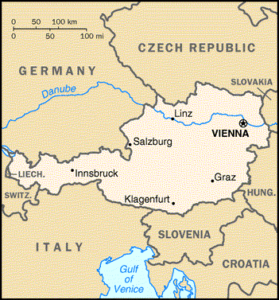
Vienna
9220882
The main language spoken in Austria is:
German - the official language nationwide, spoken by ~88.6% of the population.
Croatian is official in Burgenland, and Slovene is official in southern Carinthia, reflecting regional minority protections.
Turkish (~2.3%), Serbian (~2.2%), and Hungarian (official in Burgenland) are also spoken by minority communities.
German is the sole official national language of Austria, with Croatian, Slovene, and Hungarian holding regional official status.
| Geography |
Location: Central Europe, landlocked, north of Italy and Slovenia
Map references: Europe
Area:
total: 83,871-83,879 sq km
Land boundaries:
border countries: Czech Republic, Germany, Hungary, Italy, Liechtenstein, Slovakia, Slovenia, Switzerland (8 countries)
Terrain: in the west, mostly mountainous (Eastern Alps); east has lowlands
| People |
Population: 9,159,993-9,179,693 (2024 est.)
Life expectancy at birth:
total population: 81.5-82.27 years
male: 79.44 years
female: 85.04 years
Infant mortality rate: 3.24 deaths/1,000 live births
Nationality:
noun/adjective: Austrian(s)
Ethnic groups: Austrian 80.8%, German 2.6%, Bosnian and Herzegovinian 1.9%, Turkish 1.8%, Serbian 1.6%, Romanian 1.3%, other 10% (2018 est.; by country of birth)
Religions: Roman Catholic 55.2%, Muslim 8.3%, Orthodox 4.9%, Evangelical Christian 3.8%, none 22.4% (2021 est.)
Languages: German (official nationwide) 88.6%, Turkish 2.3%, Serbian 2.2%, Croatian (official in Burgenland) 1.6%, other (Slovene, official in southern Carinthia; Hungarian, official in Burgenland) 5.3% (2001 est.)
Population distribution: just over half the population lives in urban areas; roughly one in five Austrians lives in the greater Vienna area alone
| Government |
Country name:
conventional long form: Republic of Austria
conventional short form: Austria
Data code: AU
Government type: federal parliamentary republic
National capital: Vienna
| Economy |
Economy - overview: one of the strongest EU and Eurozone economies; diversified trade portfolio; historically significant Russian energy dependence, with growing investment in alternative energy; aging labor force offset partly by a large refugee/immigrant population; sizable government debt
GDP (purchasing power parity): $686.44 billion (2025 est.)
GDP - real growth rate: 0.4% (2024)
GDP - per capita: $74,981 PPP (2025 est.)
Inflation rate: 3.9% (2024)
Unemployment rate: 5.6% (2025 est.)
Labor force: 4,559,603 (2019)
Industries: construction, machinery, vehicles and parts, food, metals, chemicals, lumber and paper, electronics, tourism
Currency: Euro (EUR)