Languages spoken in Bolivia
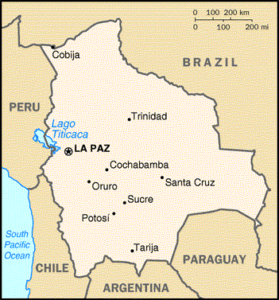
La Paz
11365333
The main languages spoken in Bolivia are:
Spanish - the most widely spoken official language, ~68.1% of the population.
Quechua (~17.2%) and Aymara (~10.5%) - also official languages, spoken by Bolivia''s large indigenous population.
Guarani (~0.6%) and 34 other native languages are also officially recognized.
Spanish and all Indigenous languages hold official status in Bolivia.
| Geography |
Location: Central South America, landlocked, southwest of Brazil
Map references: South America
Area:
total: 1,098,581 sq km
Land boundaries:
border countries: Argentina, Brazil, Chile, Paraguay, Peru
Geography - note: landlocked; the Bolivian Navy patrols Lake Titicaca and roughly 5,000 miles of navigable rivers, a legacy of the loss of coastal access to Chile in the War of the Pacific (1879-1883)
| People |
Population: 11,312,620-12,290,945 (2024 est.)
Life expectancy at birth: total population 68.6 years (World Bank, 2025)
Nationality:
noun/adjective: Bolivian(s)
Ethnic groups: indigenous peoples make up approximately 38.7% of the population (2024 census), predominantly in the Andean Plateau, Gran Chaco, and Amazon regions
Religions: predominantly Roman Catholic, with widespread syncretism with traditional Indigenous beliefs; Protestant and Mormon minorities
Languages: Spanish (official) 68.1%, Quechua (official) 17.2%, Aymara (official) 10.5%, Guarani (official) 0.6%, other 1.5% (2012 est.); Spanish and all Indigenous languages are official
| Government |
Country name:
conventional long form: Plurinational State of Bolivia
conventional short form: Bolivia
Data code: BL
Government type: presidential republic
National capital: Sucre (constitutional/legal capital, seat of the judiciary); La Paz (seat of government)
Background: named after independence fighter Simon Bolivar; broke away from Spanish rule in 1825; its subsequent history included nearly 200 coups and counter-coups; comparatively democratic civilian rule was established in the 1980s
| Economy |
Economy - overview: lower-middle-income, developing economy; historically dependent on natural gas and mineral exports; facing economic headwinds and high inflation in recent years
GDP (purchasing power parity): $161.8 billion (2026 est.)
GDP - real growth rate: -3.3% (2026f)
GDP - per capita: $12,692 PPP (2026f)
Inflation rate: 26.1% (2026f)
Population below poverty line: 36.5% (2023)
Labor force: 5,423,333 (2019)
Currency: Bolivian boliviano (BOB)
| Military |
Military branches: Bolivian Armed Forces (FAB): Army, Navy, Air Force; Ministry of Government: National Police (2025)
Military service age and obligation: voluntary for men and women 18-22; selective 12-month compulsory service for men (24 months of search-and-rescue service can substitute) (2025)
| Transnational Issues |
Trafficking in persons - tier rating: Tier 2 Watch List (2025)