Languages spoken in Greece
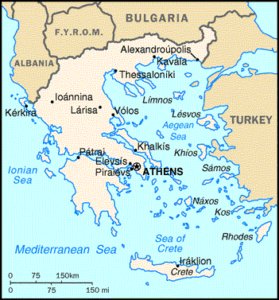
Athens
10372335
The main language spoken in Greece is:
Greek - the official language, spoken by ~99% of the population; the modern language descends directly from the language of Homer and Classical Greece.
English and French are also spoken as secondary languages by a small percentage of the population.
Approximately 12% of the English vocabulary derives from Greek, particularly in science, mathematics, and technology terms.
Greek is the sole official language of Greece.
| Geography |
Location: Southern Europe, bordering the Aegean Sea, Ionian Sea, and Mediterranean Sea, between Albania and Turkey
Map references: Europe
Area:
total: 131,957 sq km
Land boundaries:
border countries: Albania, Bulgaria, North Macedonia, Turkey
Terrain: mostly mountains with ranges extending into the sea as peninsulas or chains of islands; a peninsular country with an archipelago of about 2,000 islands
Natural hazards: severe earthquakes; Santorini is classified as a "Decade Volcano" due to its explosive history and proximity to human populations; Methana and Nisyros are also historically active volcanoes
Geography - note: strategic location dominating the Aegean Sea and the southern approach to the Turkish Straits
| People |
Population: 10,424,536 (2025 est.)
Age structure:
0-14 years: 13.9%
15-64 years: 62.6%
65 years and over: 23.6% (2024 est.)
Median age: 46.2 years (2023 est.)
Life expectancy at birth:
total population: 82.8 years
male: 79.8 years
female: 84.7 years
Nationality:
noun/adjective: Greek(s)
Ethnic groups: Greek 91.6%
Religions: Greek Orthodox 81-90% (2021); freedom of religion is guaranteed by the constitution
Languages: Greek (official) 99%, other (includes English and French) 1%
Literacy: total population 97.94% (male 98.5%, female 97.4%) (2018 est.)
Population distribution: one-third of the population lives in and around metropolitan Athens; the rest of the country has moderate population density with sizeable urban clusters
| Government |
Country name:
conventional long form: Hellenic Republic
conventional short form: Greece
local short form: Ellas or Ellada
Data code: GR
Government type: parliamentary republic
National capital: Athens
Executive branch:
chief of state: President Konstantinos TASOULAS (elected 2025 by Parliament)
head of government: Prime Minister (leader of the majority party/coalition)
| Economy |
Economy - overview: advanced, high-income EU and Eurozone economy; world''s #1 shipping industry by tonnage; strong tourism sector; recovering from the 2010s debt crisis with continued fiscal reforms
GDP (purchasing power parity): $488.57 billion (2026f)
GDP - real growth rate: 2.1% (2025)
GDP - per capita: $47,175 PPP (2026f)
Inflation rate: 5.4% (April 2026)
Unemployment rate: 8.5-9.5% (2025-2026); youth unemployment 18.4% (April 2026)
Labor force: 4,771,024 (April 2026)
Industries: shipping (world''s 1st by tonnage), tourism, petroleum refining, food processing, renewable energy, aluminium and metal products, chemicals, pharmaceuticals, machinery, ICT services
Exports: EUR 48.66 billion (2025); refined petroleum, food and beverages, manufactured goods, chemicals
Currency: Euro (EUR)
| Military |
Military branches: Hellenic Armed Forces (HAF): Hellenic Army (includes National Guard), Hellenic Navy, Hellenic Air Force (includes air defense) (2025)
| Terrorism |
Terrorist group(s): Islamic State of Iraq and ash-Sham (ISIS); Revolutionary Struggle (RS); Revolutionary People''s Liberation Party/Front (DHKP/C)