Languages spoken in India
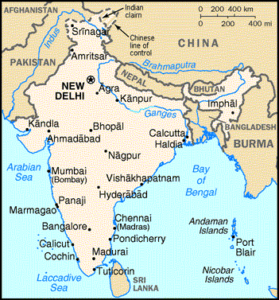
New Delhi
1417492000
The main languages spoken in India are:
Hindi - spoken by ~43.6% of the population, the most widely spoken language.
Bengali (8%), Marathi (6.9%), Telugu (6.7%), Tamil (5.7%), Gujarati (4.6%), Urdu (4.2%), Kannada (3.6%), Odia (3.1%), Malayalam (2.9%), and Punjabi (2.7%) are also widely spoken.
English is a subsidiary official language and is the most important language for national, political, and commercial communication.
India recognizes 22 official scheduled languages in total, including Assamese, Sanskrit, Sindhi, and Santali, among others.
Hindi and English serve as India''s two major lingua francas, with 22 languages holding official state recognition.
| Geography |
Location: Southern Asia, bordering the Arabian Sea and the Bay of Bengal, between Burma and Pakistan
Map references: Asia
Land boundaries:
border countries: Bangladesh, Bhutan, Burma, China, Nepal, Pakistan
Natural resources: 4th-largest coal reserves in the world; also significant deposits of antimony, iron ore, lead, manganese, mica, bauxite, rare earth elements, titanium ore, chromite, natural gas, diamonds, petroleum, limestone
| People |
Population: 1,409,128,296-1,428,627,663 (2024 est.) - most populous country in the world, having surpassed China in 2023
Age structure:
0-14 years: 24.5%
15-64 years: 68.7%
65 years and over: 6.8% (2024 est.)
Median age: 30.1 years (2025 est.)
Nationality:
noun/adjective: Indian(s)
Ethnic groups: Indo-Aryan 72%, Dravidian 25%, other 3%
Religions: Hindu 79.8%, Muslim 14.2%, Christian 2.3%, Sikh 1.7%, other/unspecified 2% (2011 est.)
Languages: Hindi 43.6%, Bengali 8%, Marathi 6.9%, Telugu 6.7%, Tamil 5.7%, Gujarati 4.6%, Urdu 4.2%, Kannada 3.6%, Odia 3.1%, Malayalam 2.9%, Punjabi 2.7%, Assamese 1.3%, Maithili 1.1%, other 5.6%; English is the subsidiary official language and most important for national, political, and commercial communication; 22 languages hold official recognition: Assamese, Bengali, Bodo, Dogri, Gujarati, Hindi, Kannada, Kashmiri, Konkani, Maithili, Malayalam, Manipuri, Marathi, Nepali, Odia, Punjabi, Sanskrit, Santali, Sindhi, Tamil, Telugu, Urdu (2011 est.)
Population distribution: very high population density throughout most of the country, except deserts in the northwest and the mountain fringe in the north; core population is in the north along the banks of the Ganges, with other river valleys and southern coastal areas also densely populated
| Government |
Country name:
conventional long form: Republic of India
conventional short form: India
local long form: Republic of India/Bharat Ganarajya
Data code: IN
Government type: federal parliamentary republic
National capital: New Delhi
Executive branch:
chief of state: President Droupadi MURMU (since 25 July 2022)
head of government: Prime Minister Narendra MODI (since 26 May 2014)
Administrative divisions: 28 states and 8 union territories
| Economy |
Economy - overview: capitalized on its large, educated, English-speaking population to become a major exporter of IT services, business outsourcing, and software talent; developing into an open-market economy, with traces of earlier autarkic policies remaining; economic liberalization since the early 1990s (industrial deregulation, privatization, reduced trade/investment controls) has driven strong long-term growth
GDP (purchasing power parity): $18.90 trillion (2026 est.) - 3rd largest in the world by PPP
GDP - real growth rate: 7.6% (2025)
GDP - per capita: $12,964 PPP (2026 est.)
Inflation rate: 3.48% (March 2026)
Unemployment rate: 4.9% (March 2025)
Labor force: approximately 610 million (2025)
Population below poverty line: 23.9% (2022)
Currency: Indian rupee (INR)
| Communications |
Broadcast media: Doordarshan, India''s public TV network, has a monopoly on terrestrial broadcasting with about 20 national, regional, and local services; large number of privately owned TV stations distributed via cable and satellite, offering over 850 channels; government controls AM radio via All India Radio; privately owned FM stations permitted since 2000 and rapidly increasing (2020)