Languages spoken in Kenya
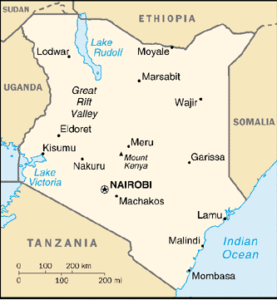
Nairobi
53330978
The main languages spoken in Kenya are:
English - an official language, used in government, business, and education.
Kiswahili (Swahili) - also an official language, serving as a unifying lingua franca among Kenya''s many ethnic communities.
Numerous indigenous languages are spoken across Kenya''s more than 40 distinct ethnic groups, including Kikuyu, Luhya, Kalenjin, Luo, and Kamba.
Both English and Kiswahili are official languages of Kenya.
| Geography |
Location: Eastern Africa, bordering the Indian Ocean, between Somalia and Tanzania
Map references: Africa
Area:
total: 580,367 sq km
Land boundaries:
border countries: Ethiopia, Somalia, South Sudan, Tanzania, Uganda
Natural hazards: recurring drought; flooding during rainy seasons; limited volcanism (The Barrier, last erupted 1921; South Island the only other historically active volcano)
Geography - note: the Kenyan Highlands comprise one of the most successful agricultural production regions in Africa; glaciers are found on Mount Kenya, Africa''s second-highest peak; Lake Victoria, the world''s largest tropical lake, is shared among Kenya, Tanzania, and Uganda
| People |
Population: 55,751,717-58,246,378 (2024-2025 est.); 27th most populous country in the world, 7th in Africa
Life expectancy at birth:
total population: 70.4 years
male: 68.6 years
female: 72.2 years (2024 est.)
Urbanization: 29.5% of the population is urban (2023)
Nationality:
noun/adjective: Kenyan(s)
Ethnic groups: Kikuyu 17.1%, Luhya 14.3%, Kalenjin 13.4%, Luo 10.7%, Kamba 9.8%, Somali 5.8%, Kisii 5.7%, Mijikenda 5.2%, Meru 4.2%, Maasai 2.5%, Turkana 2.1%, other 8.2% (2019 est.); over 40 distinct ethnic groups total
Religions: Christian 85.5% (Protestant 33.4%, Catholic 20.6%, Evangelical 20.4%), Muslim 10.9%, other 1.8%, none 1.6% (2019 est.)
Languages: English (official), Kiswahili (official), numerous indigenous languages
Population distribution: heavily concentrated in the west along the shore of Lake Victoria; other high-density areas include the capital region
| Government |
Country name:
conventional long form: Republic of Kenya
conventional short form: Kenya
Data code: KE
Government type: presidential republic
National capital: Nairobi
Independence: 12 December 1963 (from the UK); 12 December 1964 (republic declared)
Legal system: mixed system of English common law, Islamic law, and customary law; Supreme Court reviews laws
Executive branch:
chief of state and head of government: President William RUTO (since 13 September 2022)
Constitution: current constitution passed by referendum on 4 August 2010
| Economy |
Economy - overview: one of the largest economies in Sub-Saharan Africa; driven primarily by agriculture, tourism, and a growing technology sector; a regional hub for East Africa
GDP (purchasing power parity): $430.22-430.32 billion (2026 est.)
GDP - real growth rate: 4.8% (2025)
GDP - per capita: $7,930 PPP (2026 est.)
Inflation rate: 4.3% (2026)
Unemployment rate: 5.4% (2025 est.)
Population below poverty line: 14% (2022 est.)
Currency: Kenyan shilling (KES)
| Military |
Military branches: Kenya Defense Forces (KDF): Kenya Army, Kenya Navy, Kenya Air Force; Ministry of Interior: National Police Service, Kenya Coast Guard (2025)
| Terrorism |
Terrorist group(s): al-Shabaab