Languages spoken in Tanzania
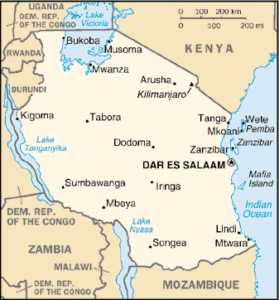
Dar es Salaam
68153004
The main languages spoken in Tanzania are:
Kiswahili (Swahili) - the official language, serving as a common lingua franca across much of East Africa; Kiunguja is the local name for Swahili in Zanzibar.
English - also official, the primary language of commerce, administration, and higher education.
Arabic is widely spoken in Zanzibar, and many local languages are spoken across Tanzania''s more than 130 ethnic groups.
Kiswahili (Swahili) and English are both official languages of Tanzania.
| Geography |
Location: Eastern Africa, bordering the Indian Ocean, between Kenya and Mozambique
Map references: Africa
Area:
total: 947,303 sq km
Land boundaries:
border countries: Burundi, Democratic Republic of the Congo, Kenya, Malawi, Mozambique, Rwanda, Uganda, Zambia (8 countries)
Geography - note: Kilimanjaro is the highest point in Africa and one of only three glaciated mountain ranges on the continent; Tanzania borders three of Africa''s largest lakes - Lake Victoria (world''s second-largest freshwater lake), Lake Tanganyika (world''s second-deepest), and Lake Nyasa (Lake Malawi)
| People |
Population: 63.9-73 million (varies by source; 2022-2025 est.)
Life expectancy at birth: total population 70.19 years (male 68.42, female 72.02)
Infant mortality rate: 28.4-30.87 deaths/1,000 live births
Nationality:
noun/adjective: Tanzanian(s)
Ethnic groups: mainland - African 99% (of which 95% are Bantu, consisting of more than 130 tribes), other 1% (Asian, European, Arab); Zanzibar - Arab, African, mixed Arab and African
Languages: Kiswahili/Swahili (official), Kiunguja (Swahili in Zanzibar), English (official, primary language of commerce/administration/higher education), Arabic (widely spoken in Zanzibar), many local languages
| Government |
Country name:
conventional long form: United Republic of Tanzania
conventional short form: Tanzania
Data code: TZ
Government type: presidential republic
National capital: Dodoma (official); Dar es Salaam (largest city, commercial capital)
Independence: 26 April 1964 (union of Tanganyika, independent 9 December 1961, and Zanzibar, independent 19 December 1963)
Background: Tanzania''s long history of integration into trade networks spanning the Indian Ocean and the African interior led to the development of Swahili as a common language across much of East Africa and the introduction of Islam into the region; contains some of Africa''s most iconic national parks and famous paleoanthropological sites
| Economy |
Economy - overview: low-income, least-developed East African economy; agriculture remains a significant sector alongside growing industry and services; steady growth in recent years, though poverty remains widespread
GDP (purchasing power parity): $293.59-293.63 billion (2025 est.)
GDP - real growth rate: 6.0% (2025)
GDP - per capita: $4,370 PPP (2025 est.)
Inflation rate: 3.9% (2020 est.)
Population below poverty line: 26.4% (2018)
Currency: Tanzanian shilling (TZS)
| Military |
Military branches: Tanzania People''s Defense Forces (TPDF): Land Forces, Naval Forces, Air Force, Nation Building Army (JKT), Reserve Forces; Ministry of Home Affairs: Tanzania Police Force (2025)
Military - note: maintains significant troop deployments abroad, including in the Central African Republic, DRC, Lebanon, and Mozambique (assisting with counterinsurgency under a bilateral agreement) (2025)